Sunscreen: What Actually Protects You
It's What You Do With It
SkinBestie ·
You already know you’re supposed to wear sunscreen. You’ve been told it’s the most important product in your routine, and you’ve probably got one somewhere — bought in good faith, maybe an SPF 30, maybe a 50 because a higher number felt safer. So here’s a slightly uncomfortable question: are you sure it’s protecting you?
Not because you bought the wrong one — almost certainly you didn’t, and this isn’t a lecture about the number you should have picked instead. It’s closer to the opposite. The thing almost nobody gets told about sunscreen is that the number does less of the work than you’d think. Get to SPF 30 or above and it has done its job; what decides how much protection you actually get — far more than 30 versus 50, far more than the brand or where it was made — is what you do with it. And that’s the part that tends to get skipped, because there’s nothing to sell you in it.
Which is good news, once it lands. It means protection isn’t another pricey product to track down; it’s a handful of things you can start getting right, most of them free, with the bottle you already own. So this post is those things: what actually makes sunscreen work, why, and how to recognise a good one when you’re standing in the aisle. Get them right and SPF stops being the step you half-do out of guilt, and becomes the one part of your routine protecting your skin in a way nothing else can.
Wear it every day, not just sunny days
The single most valuable thing you can do with sunscreen is also the simplest: wear it every day. Not just on holiday, not just when the sun’s out, not just in summer — every day, full stop.
That runs against a reasonable intuition. Sun damage feels like a fair-weather, mid-summer, on-the-beach problem — something that happens on the obvious days and takes the rest off. It doesn’t. The exposure that quietly ages skin and drives skin cancer is mostly the incidental kind: the walk to the station, the seat by the office window. Not one scorching afternoon, but the sum of hundreds of ordinary ones over the years.
Two facts the intuition gets wrong make that concrete. Cloud doesn’t switch UV off — up to around 80% comes straight through, so an overcast day isn’t a day off. And UVA, the wavelength doing most of the long-term ageing, passes through glass, which is why sun damage builds up on the side of your face nearest the car window, and why the sunny desk you sit beside all day counts too. The version of UV that ages you isn’t waiting for a blue sky; it’s there on the days that feel completely safe.
Here’s why that matters more than it sounds. Sunscreen is the only step in a routine working on damage before it happens rather than after — and this is the kind of damage nothing you apply later can undo. A good serum can soften how it looks, but nothing rewinds the exposure that caused it. Which is why, with sun, prevention is worth so much more than repair.
So the highest-return move in this whole post costs nothing and adds nothing to your basket — making sunscreen a daily habit rather than a sunny-day decision. Worn only on the obviously sunny days, even a good sunscreen protects a fraction of what you’re exposed to. Worn every day, whatever the forecast, it protects the rest.
Use enough — and it’s more than you think
The second thing that decides whether sunscreen works, once you’re wearing it daily, is how much you put on. And this is where nearly everyone falls short, usually without knowing it: most people apply somewhere between a quarter and a half of the amount a sunscreen is tested with. The number on the bottle is a best case, measured in a lab with a thick, even layer almost nobody actually uses.
Here’s the part that makes that matter. You’d reasonably assume that applying half as much gives you half the protection. It doesn’t — it gives you far less, because the drop isn’t proportional. Applied the way most people apply it, an SPF 50 behaves closer to an SPF 7.
Which means the fix isn’t the one people reach for. Faced with wanting more protection, the instinct is to buy a higher number — but a higher number applied just as thinly is still thin. The answer is more product, not a bigger figure. An easy way to gauge it for your face is the two-finger rule: squeeze sunscreen in two lines along the length of your index and middle fingers, and that’s roughly the right amount for your face and neck. It’s a rough guide, not a precise measurement — fingers differ, faces differ — but that’s exactly what makes it useful: the real problem it fixes is that most people apply far too little, and two fingers gets you close to enough when a quick blob doesn’t. It’s almost certainly more than you’re using now. The amount doesn’t change with the SPF, either: an SPF 50 needs the same generous layer as an SPF 30, because the number assumes you’ve applied the full amount whichever you pick.
This is also why the SPF built into a moisturiser or a foundation isn’t the real thing. You apply those for how they look and feel, in a thin cosmetic layer — nobody’s pressing two fingers of foundation onto their face — so you get a fraction of the number printed on them. That doesn’t make them useless; on a day you’re barely outdoors, a bit of SPF is better than none. But treat it as a bonus, not the plan. The thing actually protecting your skin is a dedicated sunscreen, applied properly, as its own step.
Cover the bits everyone misses — and reapply
Applying enough is half the job. The other half is getting it everywhere — and there’s a predictable set of places people miss, even when they think they’ve been thorough. Under UV photography, which shows up bare skin as bright and covered skin as dark, the same spots get skipped again and again: the ears, the hairline, the sides and back of the neck, the tops of the hands and feet. The eye area is the worst of all — the eyelids, and especially the inner corner where the lids meet, get missed by most people even after they’ve been told to watch for it. That matters more than it sounds, because the eyelids are one of the highest-risk sites on the whole body for skin cancer.
A few are worth naming, because they’re the easiest to forget:
- Ears and scalp. If your hair is short or worn up, your ears and the parting of your scalp take direct sun — work a little sunscreen along the parting and over any thinning or bare areas, or wear a hat.
- Lips. They have no real protection of their own, and a plain balm doesn’t help — an SPF lip balm does a job nothing else does.
- Under a beard. Facial hair shields the skin beneath less well than it looks like it should, so the skin around and under it still needs covering.
Then there’s reapplying — and it’s worth being clear about why, because the usual framing is misleading. Sunscreen isn’t a timer. You don’t reapply because a countdown has run out; you reapply because the layer physically wears away over the day — rubbed off on clothes and hands, sweated off, washed off. Reapplying puts the layer back. Nothing about a higher SPF changes this: a bigger number doesn’t last longer, it just means you reapply the same way.
The most useful reapplication is the one almost nobody does — and it’s early. Because that first coat in the morning is usually thin, a second coat about fifteen to thirty minutes after the first roughly doubles what’s on your skin, filling the gaps the first one left. Worth being clear about what that does: it doesn’t push you above the SPF on the bottle — it gets you up to it, taking that thin first layer closer to the amount the number was actually measured with. After that, the sensible rhythm is to reapply after anything that removes it — swimming, heavy sweating, towelling dry — and roughly every couple of hours if you’re out in strong sun for a stretch, because in real life the layer is quietly wearing away whether you notice it or not.
The number is only half the label
One last thing worth knowing before you close the tab, because it changes what you look for. The SPF number only measures protection against UVB — the rays that burn. It tells you nothing about UVA: the deeper rays that do most of the ageing, pass through glass, and are around all year. So the number really is only half the story — a sunscreen can carry a high SPF and still leave the ageing half of the job half-done.
Which means there are three things worth a glance on any bottle:
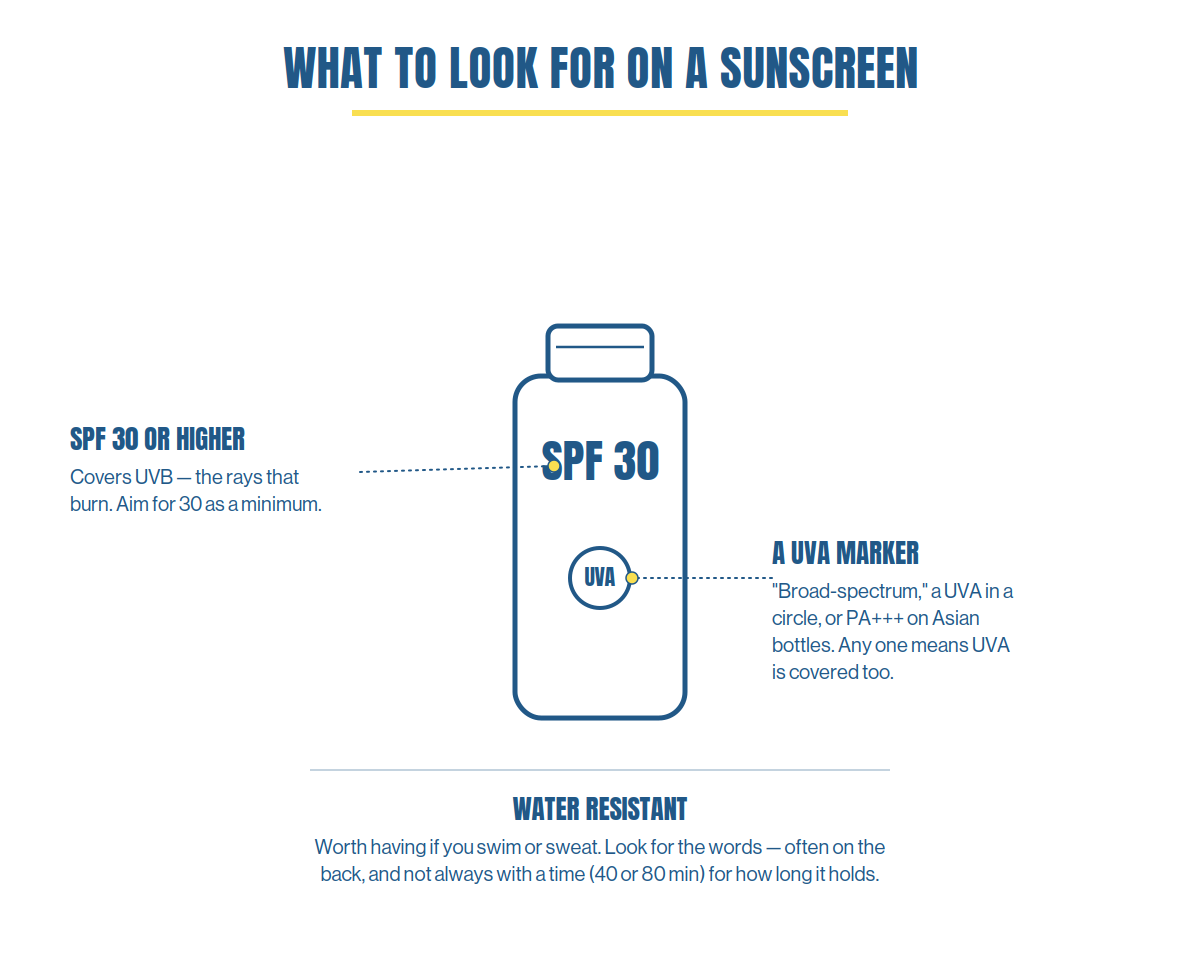
Those three are enough to pick a sunscreen that actually covers you. Going further than that — which UVA markers are strongest, mineral versus chemical versus tinted, and what suits your particular skin and concerns like pigmentation — is a proper subject in its own right, and it’s getting its own post. For now, those basics plus the habits above are what matter.
The best sunscreen is the one you’ll actually wear
Here’s what ties all of this together. Everything in this post — wearing it daily, using enough, covering the bits people miss, reapplying — only happens if you actually reach for the bottle. Which means the quality that matters most in a sunscreen isn’t its SPF, its filter, or where it was made. It’s whether you like wearing it enough to put it on every morning without it feeling like a chore.
That’s not a small thing — it’s the whole game. A sunscreen that stings your eyes, leaves a cast, or feels heavy is one you’ll quietly skip, and a skipped SPF 50 protects you far less than an SPF 30 you’re happy to wear. So when you’re choosing, weight how it feels as heavily as what it claims — a texture you like and a finish that sits well under everything else aren’t vanity, they’re what make protection actually happen, day after day.
So if one idea leaves with you, let it be this: stop hunting for the highest number, and find the SPF 30 or higher you’ll happily wear every day and reapply. That’s the one that actually protects you — not the one that looked best on paper.
References
American Academy of Dermatology. (n.d.). Sunscreen FAQs.
Diffey, B. L. (2001). When should sunscreen be reapplied? Journal of the American Academy of Dermatology, 45(6), 882–885. https://doi.org/10.1067/mjd.2001.117385
Faurschou, A., & Wulf, H. C. (2007). The relation between sun protection factor and amount of sunscreen applied in vivo. British Journal of Dermatology, 156(4), 716–719. https://doi.org/10.1111/j.1365-2133.2006.07684.x
Gabros, S., Patel, P., & Zito, P. M. (2025). Sunscreens and photoprotection. StatPearls.
Gordon, J. R. S., & Brieva, J. C. (2012). Unilateral dermatoheliosis. New England Journal of Medicine, 366(16), e25. https://doi.org/10.1056/NEJMicm1104059
Green, A., Williams, G., Neale, R., Hart, V., Leslie, D., Parsons, P., Marks, G. C., Gaffney, P., Battistutta, D., Frost, C., Lang, C., & Russell, A. (1999). Daily sunscreen application and betacarotene supplementation in prevention of basal-cell and squamous-cell carcinomas of the skin: A randomised controlled trial. Lancet, 354(9180), 723–729. https://doi.org/10.1016/S0140-6736(98)12168-2
Heerfordt, I. M., Torsnes, L. R., Philipsen, P. A., & Wulf, H. C. (2018). Sunscreen use optimized by two consecutive applications. PLoS One, 13(3), e0193916. https://doi.org/10.1371/journal.pone.0193916
Hughes, M. C. B., Williams, G. M., Baker, P., & Green, A. C. (2013). Sunscreen and prevention of skin aging: A randomized trial. Annals of Internal Medicine, 158(11), 781–790. https://doi.org/10.7326/0003-4819-158-11-201306040-00002
Lourenco, E. A. J., Shaw, L., Pratt, H., Duffy, G. L., Czanner, G., Zheng, Y., Hamill, K. J., & McCormick, A. G. (2019). Application of SPF moisturisers is inferior to sunscreens in coverage of facial and eyelid regions. PLoS One, 14(4), e0212548. https://doi.org/10.1371/journal.pone.0212548
Pratt, H., Hassanin, K., Troughton, L. D., Czanner, G., Zheng, Y., McCormick, A. G., & Hamill, K. J. (2017). UV imaging reveals facial areas that are prone to skin cancer are disproportionately missed during sunscreen application. PLoS One, 12(10), e0185297. https://doi.org/10.1371/journal.pone.0185297
Taylor, S., & Diffey, B. (2002). Simple dosage guide for suncreams will help users. BMJ, 324(7352), 1526. https://doi.org/10.1136/bmj.324.7352.1526/a
World Health Organization, World Meteorological Organization, United Nations Environment Programme, & International Commission on Non-Ionizing Radiation Protection. (2002). Global solar UV index: A practical guide.