The SkinBestie Pyramid
Why Most Skincare Routines Get the Foundation Wrong
SkinBestie ·
There’s a good chance you have a shelf somewhere that’s quietly become a graveyard: half-used bottles, a couple of things you bought because they were everywhere on TikTok, an expensive serum that promised the world and delivered very little, and at least one product you genuinely can’t remember the reason for buying. Add up what’s on it — and what you’ve spent over the last year — and it’s probably more than you’d want to say out loud.
Here’s the part that’s easy to feel and harder to admit: after all of it, you’re still not sure your skin is any better, or even that you’re using the right things. There’s a background worry that never quite goes away — the sense that everyone else has cracked this and you’re the only one still guessing.
If that’s you, the first thing worth saying is that none of it is a personal failing. Skincare is genuinely overwhelming, and not by accident — most of the industry is built to sell you the next thing, not to teach you how any of it fits together. When every product is pitched as the answer, it’s almost impossible to tell which one actually is.
So this post isn’t about adding another step to your routine. It’s about something quieter and more useful: the order things go in. Because the reason most routines don’t work usually isn’t a product you’re missing — it’s that they’ve been built in the wrong order. Get the order right, and the whole thing gets a lot simpler.
The four levels
So here’s the model we use to make that order concrete. We call it the SkinBestie Pyramid, and it’s the simplest way we’ve found to think about what belongs in a routine — and what each part is actually for.
A pyramid, because the shape does half the explaining for you. The bigger a level is, the more everything above it depends on getting it right. You don’t need a key to read it: essential at the wide bottom, optional at the narrow top.
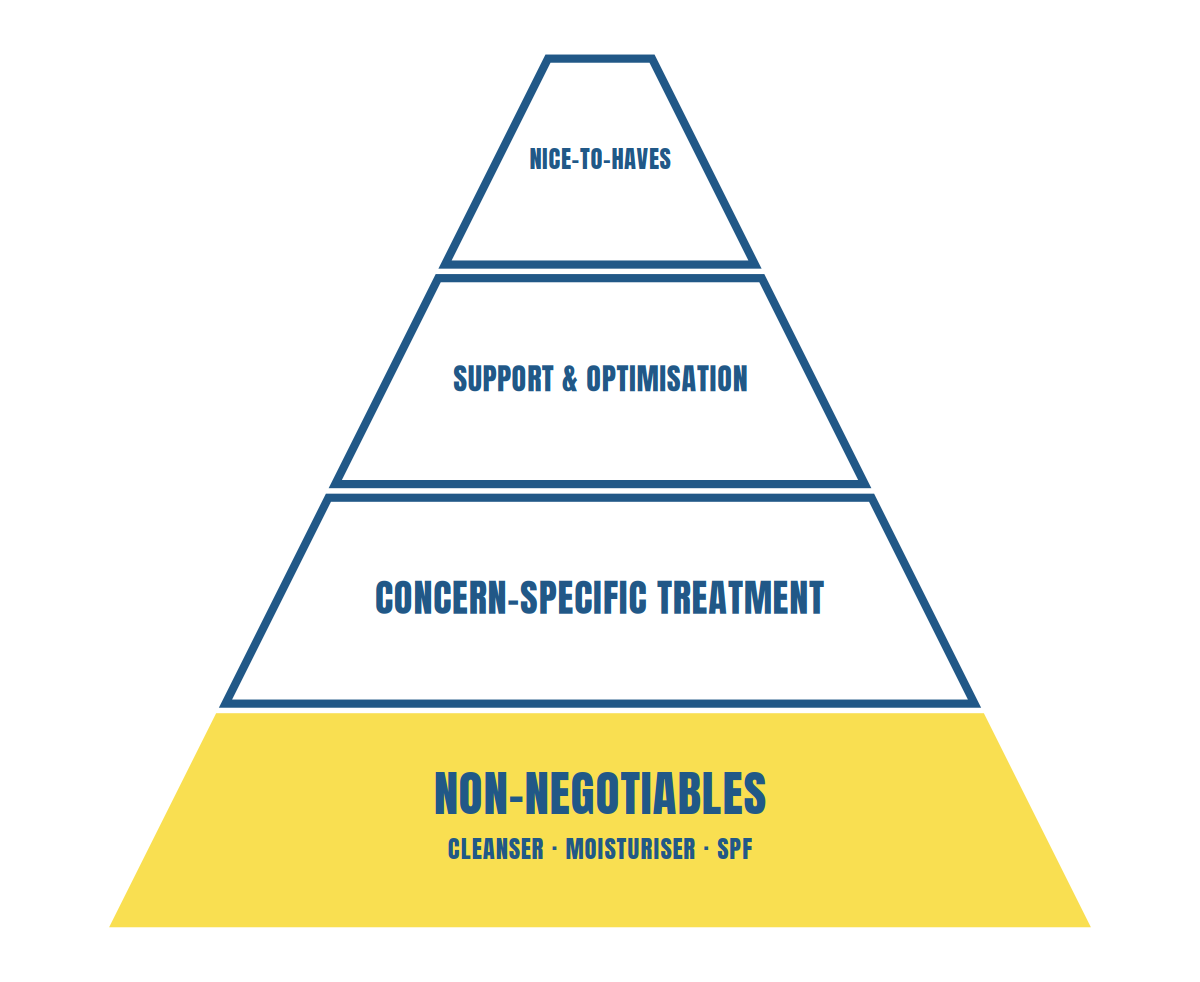
Four levels, from the ground up:
-
Level 1 — The Non-Negotiables. A cleanser, a moisturiser, and SPF. These three are the foundation of any working routine, for every skin, full stop. Not the exciting part — the part everything else depends on.
-
Level 2 — Concern-Specific Treatment. The active ingredients that target a particular concern you might have — think retinoids for fine lines, or lactic acid for smoother texture. This is the “results” layer, where visible change comes from.
-
Level 3 — Support & Optimisation. The extras that enhance the work the levels below are already doing — things like a hydrating serum, a barrier-support product, or an eye cream, added when there’s a specific reason for them. Useful, but not foundations in their own right.
-
Level 4 — Nice-to-Haves. The optional, enjoyable layer — things like a face mask or a facial mist. Pleasant, sometimes genuinely helpful, never essential.
What the shape is quietly arguing is this: the lower the level, the more it matters. So the real question was never which products to own — it’s how to build across these four levels in the right order. And that comes down to a single rule.
The one rule
If the Pyramid gives you one thing to remember, make it this:
Never build upward until the level below is solid.
Get Level 1 working before you reach for Level 2. Get Levels 1 and 2 working before Level 3 earns a place. It sounds almost too obvious to need saying — and it’s the single most common reason routines quietly fail. So it’s worth understanding why it’s true, because once you see the reason, the rule stops feeling like a rule and starts feeling like common sense.
The reason is that the upper levels don’t work in a vacuum — they work on whatever the foundation has left them. Two examples make it concrete.
A retinoid is one of the best-proven ingredients in skincare. But applied to skin whose barrier is already compromised — stripped by the wrong cleanser, or simply under-moisturised — it tends to cause irritation rather than the softer fine lines it’s capable of producing. Same ingredient, very different outcome, and the only thing that changed was what was underneath it.
SPF is the clearest case of all. Sun exposure causes damage that builds up over time and can’t be undone by anything you apply later — daily broad-spectrum SPF prevents that cumulative photodamage and reduces your skin-cancer risk, which is why it sits at Level 1. No serum higher up the pyramid can make up for a gap here, because there’s no product that reverses the damage SPF was there to prevent in the first place.
This is also where a lot of the frustration comes from — and where some relief is waiting. The instinct, understandably, is to reach straight for the exciting end: the actives, the serums, the products that promise visible change. Not because anyone’s careless, but because no one ever told us the unglamorous foundation was the part that had to come first. So if your routine isn’t delivering, the answer usually isn’t another product on top. More often it’s the opposite — permission to stop chasing the top of the pyramid, take the pressure off, and put it where it actually counts: getting the bottom solid first. That’s usually less to buy, not more.
What the Pyramid can and can’t tell you
So that’s the framework — four levels, one rule, built from the ground up. Now the honest part: what it can and can’t do for you.
What it can do is hand you a way of thinking that’s yours to keep. The four levels, the order, the never-build-upward rule — that’s the whole framework, and once it’s in your head you can bring it to any product decision you’ll ever face, with us or without us. This isn’t a taster of the real thing; it’s the real thing, and it works whether or not you ever speak to anyone about your skin.
What it can’t do is tell you which specific products are right for you. Which cleanser, which moisturiser, which SPF actually suits your skin; whether you’re ready for a retinoid yet, and which one; what belongs at your Level 2 at all — none of that can be answered honestly by a framework alone, because it depends on things a framework can’t see: your skin, your concerns, what you’ve reacted badly to before, the life you’re actually living. A pyramid that claimed to know which cleanser you should buy without ever seeing your skin would either be useless or making it up. The thinking is universal; the specifics are personal — and the personal part is where having someone look at your actual skin comes in.
Two honest things before you put any of this into practice.
The first is that the whole framework assumes your skin barrier — your skin’s outermost layer, the part that keeps moisture in and irritation out — is broadly intact. For most people, it is. But if yours is genuinely struggling, that becomes the real first thing to sort, even before the rest of this — it’s the foundation underneath the foundation, and it’s a big enough subject to be worth a proper look of its own.
The second is simpler, and the most important thing here: the Pyramid is for building a skincare routine, not for fixing something that’s genuinely wrong. If something on your skin is persistent, painful, or spreading, that’s one for your GP, not a new product. Skincare works alongside medical care — never instead of it.
Where to start
The next time something lands on your feed promising to change your skin — and the next time won’t be far off — you’ve now got a way to place it. One question does most of the work: where does this sit on the pyramid, and is the level below it already solid? If it’s a Level 2 active and your Level 1 isn’t sorted, you have your answer, and it isn’t “add to basket.” If your foundation’s solid and there’s a real reason for it, maybe it earns a place. Either way, you’re deciding from a framework instead of guessing.
And that’s the real shift here. Not a tidier shelf or a longer list of products — a way of thinking that turns “everyone else seems to have figured this out” into “I know how to figure this out.” The shelf graveyard wasn’t a sign you were doing it wrong; it was a sign no one had ever handed you the order. Now you have it.
You don’t need to overhaul everything today. Start at the bottom. Get your Level 1 right — the cleanser that suits your skin, the moisturiser you don’t skip, and the SPF you’ll actually wear every day — and let everything above it earn its place from there. That’s not the hard version of skincare. It’s the version that finally makes sense.
References
Agbai, O. N., Buster, K., Sanchez, M., Hernandez, C., Kundu, R. V., Chiu, M., Roberts, W. E., Draelos, Z. D., Bhushan, R., Taylor, S. C., & Lim, H. W. (2014). Skin cancer and photoprotection in people of color: A review and recommendations for physicians and the public. Journal of the American Academy of Dermatology, 70(4), 748–762. https://doi.org/10.1016/j.jaad.2013.11.038
American Academy of Dermatology. (n.d.). How to select sunscreen.
British Association of Dermatologists. (n.d.). The sunscreen fact sheet.
Draelos, Z. D., Ertel, K. D., & Berge, C. A. (2006). Facilitating facial retinization through barrier improvement. Cutis, 78(4), 275–281.
Fluhr, J. W., Moore, D. J., Lane, M. E., Lachmann, N., & Rawlings, A. V. (2024). Epidermal barrier function in dry, flaky and sensitive skin: A narrative review. Journal of the European Academy of Dermatology and Venereology, 38(5), 812–820. https://doi.org/10.1111/jdv.19745
Green, A., Williams, G., Neale, R., Hart, V., Leslie, D., Parsons, P., Marks, G. C., Gaffney, P., Battistutta, D., Frost, C., Lang, C., & Russell, A. (1999). Daily sunscreen application and betacarotene supplementation in prevention of basal-cell and squamous-cell carcinomas of the skin: A randomised controlled trial. The Lancet, 354(9180), 723–729. https://doi.org/10.1016/S0140-6736(98)12168-2
Green, A. C., Williams, G. M., Logan, V., & Strutton, G. M. (2011). Reduced melanoma after regular sunscreen use: Randomized trial follow-up. Journal of Clinical Oncology, 29(3), 257–263. https://doi.org/10.1200/JCO.2010.28.7078
Hughes, M. C. B., Williams, G. M., Baker, P., & Green, A. C. (2013). Sunscreen and prevention of skin aging: A randomized trial. Annals of Internal Medicine, 158(11), 781–790. https://doi.org/10.7326/0003-4819-158-11-201306040-00002
International Agency for Research on Cancer. (2012). Radiation (IARC Monographs on the Evaluation of Carcinogenic Risks to Humans, Volume 100D).
Rawlings, A. V., & Harding, C. R. (2004). Moisturization and skin barrier function. Dermatologic Therapy, 17(Suppl 1), 43–48. https://doi.org/10.1111/j.1396-0296.2004.04S1005.x